Back to Articles
Market Background
Speakers for outdoor live events hang from rigging far from the control booth, so the sound team needs a way to confirm each cabinet is powered and working without walking out to it. An indicator light on the cabinet answers that question at a glance, but only if an operator can read it from the booth. Outdoor deployment makes that small indicator hard to build. The part sits in sunlight and rain for the length of an event season, the cabinet vibrates while it plays, and transport and rigging add shock loads. Light pipes are the standard way to carry LED output from a board inside the enclosure to a visible window. A rigid plastic light pipe, though, needs separate parts to seal the opening and protect the electronics, and every added gasket, grommet, or connector raises cost and adds an assembly step that can fail in the field.
Customer Challenge
In 2024, a professional audio company approached Visual Communications Company (VCC) to add a status light to a new outdoor speaker. The client's requirement list pulled in several directions at once. The indicator needed to be visible from 150 feet away with even light output. It also had to resist UV exposure, meet IP67 water and dust protection, and hold up under vibration and shock. On the electrical side, the design had to run eight LEDs inside a 1.96 W power budget and produce matched brightness from the front and side light pipes on each side of the cabinet. The client also set a strict unit cost target and a tight launch timeline.
Balancing those competing specifications stalled the client's engineering team. The team had developed an initial concept but lacked the in-house optical expertise and simulation tools to validate and refine it. According to VCC, that concept delivered about 1% optical efficiency and 3% luminance uniformity, and its two light pipe channels differed in brightness by a ratio of 1:12. Without a working indicator, operators could not check speaker status from the control booth and would have to rely on external diagnostic tools. That usability gap threatened to push the product down into a budget speaker category.

Our Solution
VCC delivered the project as a turnkey engagement covering optical design, prototyping, and production manufacturing. Keeping all three stages with one team meant design decisions carried straight into tooling.
Choosing LEDs Within a 1.96 W Power Budget
VCC's engineers started with the light source, because the power budget limited every later decision. They compared four candidate LEDs on efficacy, cost, ease of sourcing, and drive current. The two high-power parts offered 365 lm each but drew 700 mA, which would have added heat inside a sealed enclosure, and one of them was hard to source. VCC selected the Osram GW PSLM32.UL-JSJU-NC-1-100-R18 mid-power LED, a 3 x 3 mm package rated at a typical 70 lm at 100 mA with a 120° viewing angle.
| LED candidate | Luminous flux | Drive current | Unit cost | VCC assessment |
|---|---|---|---|---|
| Osram GW CSSRM3.PM (high power) | 365 lm | 700 mA | $0.54 at 15K | High drive current adds heat |
| Nichia NVSW219FT (high power) | 365 lm | 700 mA | $0.52 | Hard to source |
| Osram GW PSLM32.UL (mid power) | 70 lm typ. | 100 mA | $0.15 at 30K | Selected |
| Lumileds L135-4070SA35000P1 (mid power) | 56 lm | 100 mA | $0.11 at 30K | Lower flux than selected part |
The cabinet needed at least two LEDs per side to light both the front and side light pipes, so VCC specified eight LEDs on two PCBs. VCC set the drive point at 2.9 V and 80 mA per LED, which holds total consumption at 1.856 W against the 1.96 W limit and yields a typical 56 lm per LED.
Replacing Rigid Optics With a Liquid Silicone Rubber Light Pipe
Sealing the light pipe opening was the constraint hardest to reconcile with cost, so VCC evaluated three mounting approaches. Two used a rigid light pipe with conformal coating on the PCB, sealed with either a waterproof grommet or a waterproof connector. The third replaced the rigid part with a flexible light pipe that seals the opening itself. VCC chose the flexible option as the best fit for manufacturability and cost.
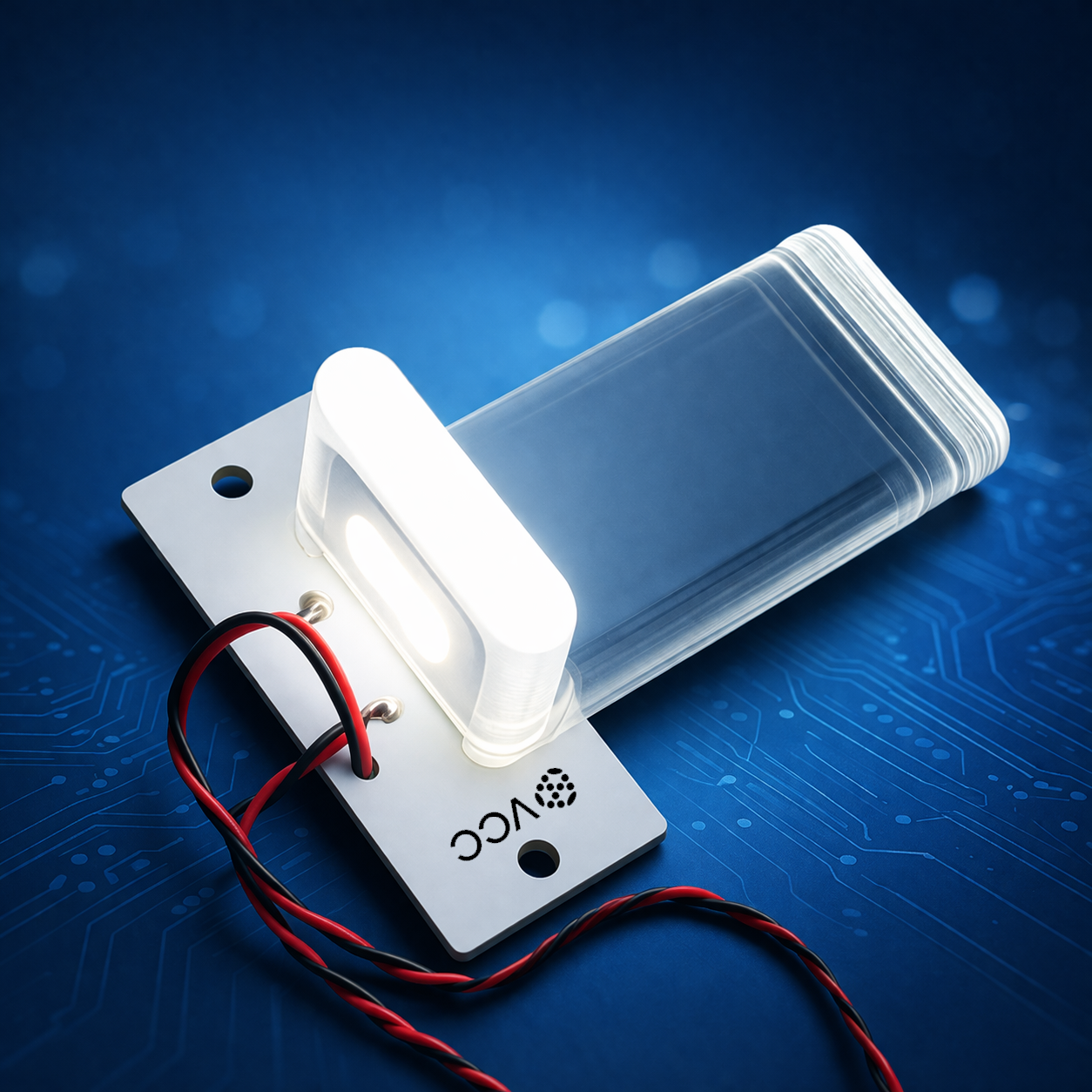
That choice depended on finding the right material. VCC specified Dow MS-1002, an optically clear liquid silicone rubber (LSR) with 92% transmittance at 10 mm thickness and a 72 Shore A durometer. VCC used LSR to handle sealing, UV resistance, and mechanical tolerance in one molded part. The other two options would have needed a multi-part rigid assembly to do the same job.

Ray-Tracing the Front and Side Light Pipes
With the material set, VCC modeled both light pipes and their LED inputs in 3D CAD and ran TracePro ray-tracing simulations to see how light entered, traveled through, and exited each part. In the first design revision, VCC's light study estimated 43.2% efficiency and 97 lm (30.9 cd) for the front light pipe. The same study put the side light pipe at 42.5% efficiency and 95 lm (30.2 cd), which met the client's requirement for matched brightness on both channels.
Sealing, Heat Transfer, and Assembly
Because the LEDs sit inside a sealed enclosure, the optical design depended on mechanical details that kept water out and moved heat away. VCC defined a sealing area where the light pipe assembly meets the speaker's rigging bar and added material and three M3 screws around it. VCC also added material that contacts the PCB directly, giving LED heat a path into the metal housing.
To keep assembly short, VCC laid out a build sequence with no separate sealing components. Assemblers insert the side and front light pipes, screw them to the housing, and place the PCBA so the board holds both light pipes in position. They then tie the wires to protect the connection from pull force, screw the PCBA to the housing, and attach the assembly to the speaker's wood shell.
| Component | Specification |
|---|---|
| Light pipe material | Dow MS-1002 liquid silicone rubber, optically clear |
| Light pipe optical properties | 92% transmittance at 10 mm thickness, 72 Shore A durometer |
| Light pipe surface finish | SPI-A2 or better, MT11400 texture |
| Light pipe manufacturing | LSR injection molding |
| Light pipe count | 4 (front and side, left and right) |
| LED | Osram GW PSLM32.UL-JSJU-NC-1-100-R18, 120° view angle, 8 units |
| LED drive | 2.9 V, 80 mA per LED, 1.856 W total |
| PCB | FR-4 or metal core, 1.6 mm, white solder mask, 4 LEDs per board |
| Connector and wiring | Hirose DF58-2S-1.2C, 28 AWG red and black wires |
| Ingress protection target | IP67 |
From Prototype to Production Tooling
Once the design was final, VCC built functional prototypes from vacuum-cast light pipes integrated with PCBAs. According to VCC, the prototypes reached 94% correlation with final mass-production quality, which gave the client a dependable preview of production performance before committing to tooling. VCC then designed and fabricated custom LSR injection molding tooling for mass production.
Result & Benefits
VCC completed the design in three months across two iteration cycles. Prototyping with full PCBA and optical assembly took five weeks, and the production phase took six months, including the custom LSR tooling.
According to VCC, the final design raised optical efficiency from 1% to 45% and luminance uniformity from 3% to 85%. VCC also brought the brightness ratio between light pipe channels from 1:12 down to 1:1.1 and cut unit cost by about 60%. VCC attributes much of that cost reduction to the single-part LSR design, which removed the separate sealing hardware a rigid light pipe would have required.

● One part for sealing and optics: VCC's LSR light pipe replaced a rigid optic plus a separate grommet or waterproof connector, removing parts and assembly steps.
● A qualified silicone supply chain: VCC qualified LSR for this application and set up a multi-vendor network for specialized silicone molding to support production.
● A material platform for future products: The client can now apply flexible LSR optics to future ruggedized outdoor electronics in its product line.
Conclusion
Designers of outdoor electronics are asking small optical parts to carry environmental, mechanical, and cost requirements that used to be split across several components. When a light pipe has to seal an opening, resist UV, and tolerate vibration, material selection becomes an optical design decision. VCC moved an outdoor speaker indicator from 1% to 45% efficiency by pairing TracePro simulation with an LSR material choice that solved sealing and cost in the same part. For manufacturers of ruggedized outdoor equipment, VCC offers optical design, prototyping, and LSR production under one team, taking an indicator light from first concept to production tooling.