Back to Articles
Introduction: Why Switch Basics Matter
Switches are at the heart of countless Human-Machine Interfaces (HMIs). From powering on industrial machinery to controlling medical equipment, the right switch ensures safety, performance, and user experience. But many engineers face the challenge of navigating between multiple switch types, electrical concepts, and design considerations.
This guide provides a clear, practical breakdown of switch fundamentals to help you design smarter, more reliable systems.
Key Switch Types and Their Ideal Applications
Different switch architectures offer distinct operational benefits depending on environment, physical footprint, and operator needs.
Pushbutton Switches
Pushbuttons operate via a simple push motion, offering either momentary or latching functionality. They are ideal for control panels, emergency resets, and consumer interface panels where rapid actuation is required.
Toggle Switches
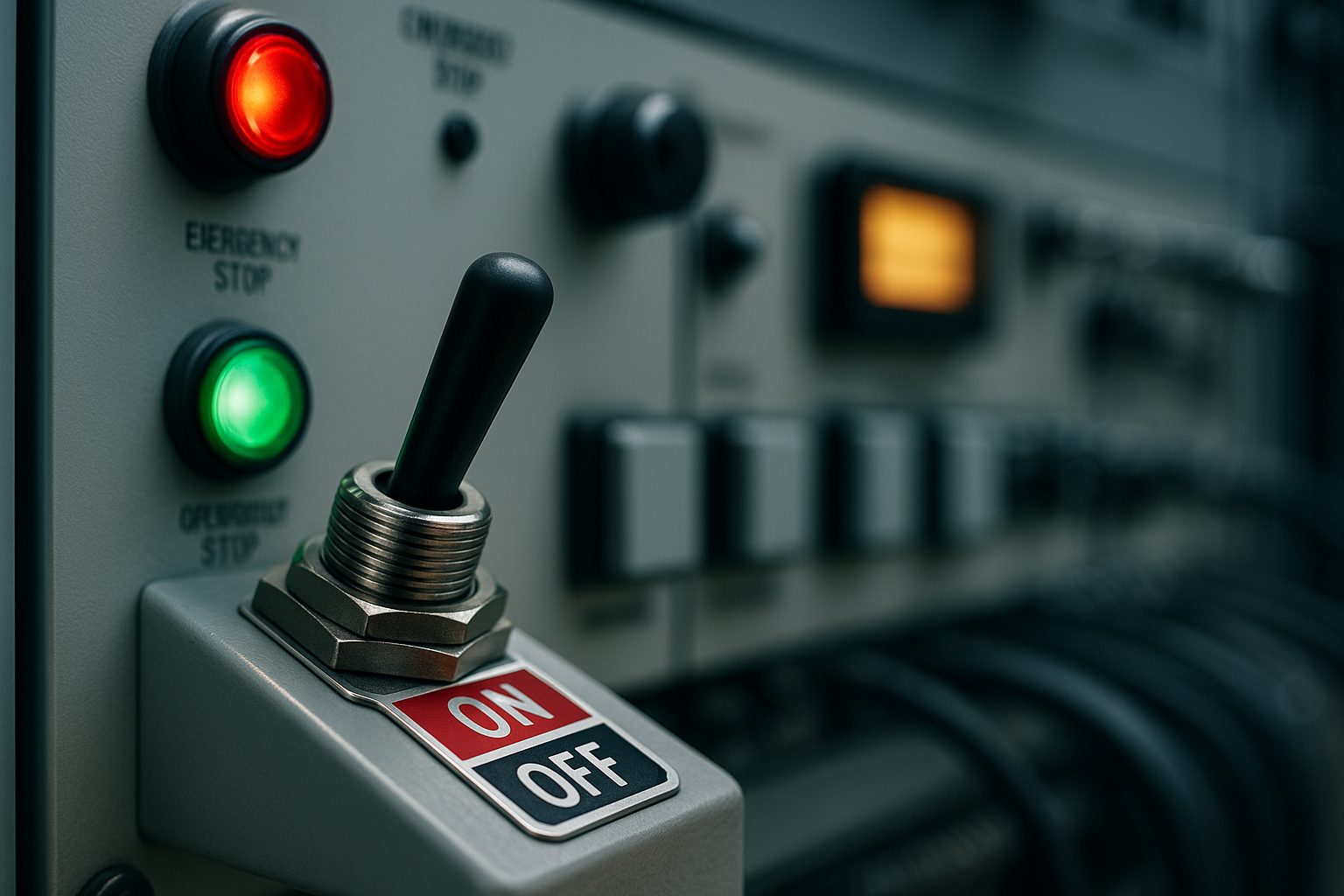
Featuring a distinct lever mechanism, toggle switches provide clear visual confirmation of switch status. They excel at high-reliability power switching in demanding industrial machinery and automotive cockpits.
Rocker Switches
Rocker switches feature a see-saw actuator that offers clear visual and tactile feedback. Commonly integrated into power supplies, test instrumentation, and commercial appliances, they allow for effortless actuation even with gloved hands.
Membrane Switches
Built with thin, flexible substrates, membrane switches deliver an ultra-low-profile and easily customizable panel interface. Their continuous sealed surface makes them ideal for sterile medical devices, cleanroom equipment, and washdown environments.
Essential Electrical Concepts for Switch Selection
Understanding basic contact behavior is critical for designing safe, functional control circuits. The two fundamental switch characteristics every engineer must consider are actuation mode and circuit state:
Actuation Mode: Momentary vs. Latching
-
Momentary Switches: Remain active only while physical pressure is applied (e.g., system resets, test triggers, or horn controls).
-
Latching Switches: Maintain their updated state after being pressed until actuated again (e.g., main power switches, mode selectors).
Contact State: Normally Open (NO) vs. Normally Closed (NC)
-
Normally Open (NO): The circuit remains open by default and closes upon actuation, allowing current to flow only when activated.
-
Normally Closed (NC): The circuit stays closed by default and opens upon actuation, interrupting current flow when activated—a key requirement for safety interlocks and emergency stop systems.
Selecting the right combination directly impacts system safety, circuit redundancy, and overall user interaction.
Switch Applications Across Key Industries
Matching switch mechanisms to specific operating conditions is essential for long-term system performance. Here is how key switch types function across core sectors:
-
Industrial Control Panels: Robust toggle and pushbutton switches provide heavy-duty durability and clear tactile feedback for critical machine operations.
-
Medical Devices: Sealed membrane switches with integrated illumination deliver cleanable, high-visibility surfaces suited for sterile environments.
-
Automotive Systems: Ergonomic rocker switches deliver intuitive tactile feedback, allowing drivers to operate controls safely without taking their eyes off the road.
-
Robotics & Automation: Custom-engineered switches integrate into compact, complex control systems to handle precise, high-cycle automation tasks.
How Do You Choose the Right Switch for Your Application?
Selecting the optimal switch requires balancing electrical requirements, mechanical wear, and operational environment. Key factors to evaluate during the design phase include:
-
Electrical Ratings: Confirm required voltage, current capacity, and load type (inductive, resistive, or capacitive) to prevent contact welding or early failure.
-
Mechanical Durability: Assess expected actuation life cycle and required tactile feedback to ensure long-term reliability under heavy use.
-
Environmental Conditions: Verify IP (ingress protection) and IK (impact protection) ratings for resistance against moisture, dust, chemicals, and mechanical shock.
-
Integration Needs: Determine mounting constraints, whether designing for PCB mounting, panel cutout installation, or custom harness assemblies.
-
User Experience: Consider ergonomics, operator handwear (such as gloves), illuminated status indication, and tactile response for intuitive operation.
Conclusion: Engineering for Switch Reliability
While digital panels evolve, mechanical switches remain essential in industrial automation for reliable human-machine interaction. By understanding switch fundamentals, types, configurations, and electrical principles, engineers can design products that are safer, more efficient, and more reliable.
At VCC, we combine decades of expertise with a wide range of industrial and specialty switches to help you bring your vision to life.
Frequently Asked Questions (FAQs)
What Are the Different Types of Switches Used in Industrial Control Panels?
The most common switches used in industrial control panels include pushbutton switches, toggle switches, rocker switches, and membrane switches. Each serves a different purpose depending on the application. Pushbutton switches are commonly used for start/stop functions, toggle switches for maintaining on/off states, rocker switches for intuitive operation, and membrane switches for compact, sealed interfaces commonly found in medical and electronic equipment.
What Is the Difference Between Momentary and Latching Switches?
The main difference between momentary vs. latching switches is how they operate. A momentary switch only remains active while it is being pressed and returns to its original position when released. A latching switch stays in its selected position until it is pressed again or manually switched back. The right choice depends on whether your application requires temporary activation or a maintained on/off state.
What Is the Difference Between Normally Open (NO) and Normally Closed (NC) Switches?
A Normally Open (NO) switch stays open by default, completing the circuit and allowing current to flow only when actuated. A Normally Closed (NC) switch maintains a closed circuit by default, interrupting current flow when actuated—making NC contacts critical for emergency stops, safety interlocks, and fail-safe logic. Learn more in our full guide on NO vs. NC switches.