Back to Articles
Why Choosing the Right Indicator Matters
In critical applications, a faulty LED indicator isn’t just an inconvenience; it can trigger severe operational hazards. From industrial machinery exposed to extreme temperatures and corrosive chemicals to outdoor signage battling UV radiation and driving rain, selecting the proper indicator is crucial for long-term reliability. Key factors such as IP rating LED indicators, vibration resistance LEDs, and housing material LED indicators are vital for project success. This guide walks engineers and purchasing teams through the essential criteria for evaluating panel mount indicators (PMIs) built with rugged designs to withstand the most challenging environments.
What Environmental Challenges Affect LED Indicators in Harsh Conditions?
Environmental challenges affecting LED indicators include temperature extremes, moisture ingress, mechanical vibration, UV degradation, corrosive chemicals, and atmospheric pressure changes—all of which can cause premature component failure if not properly mitigated.
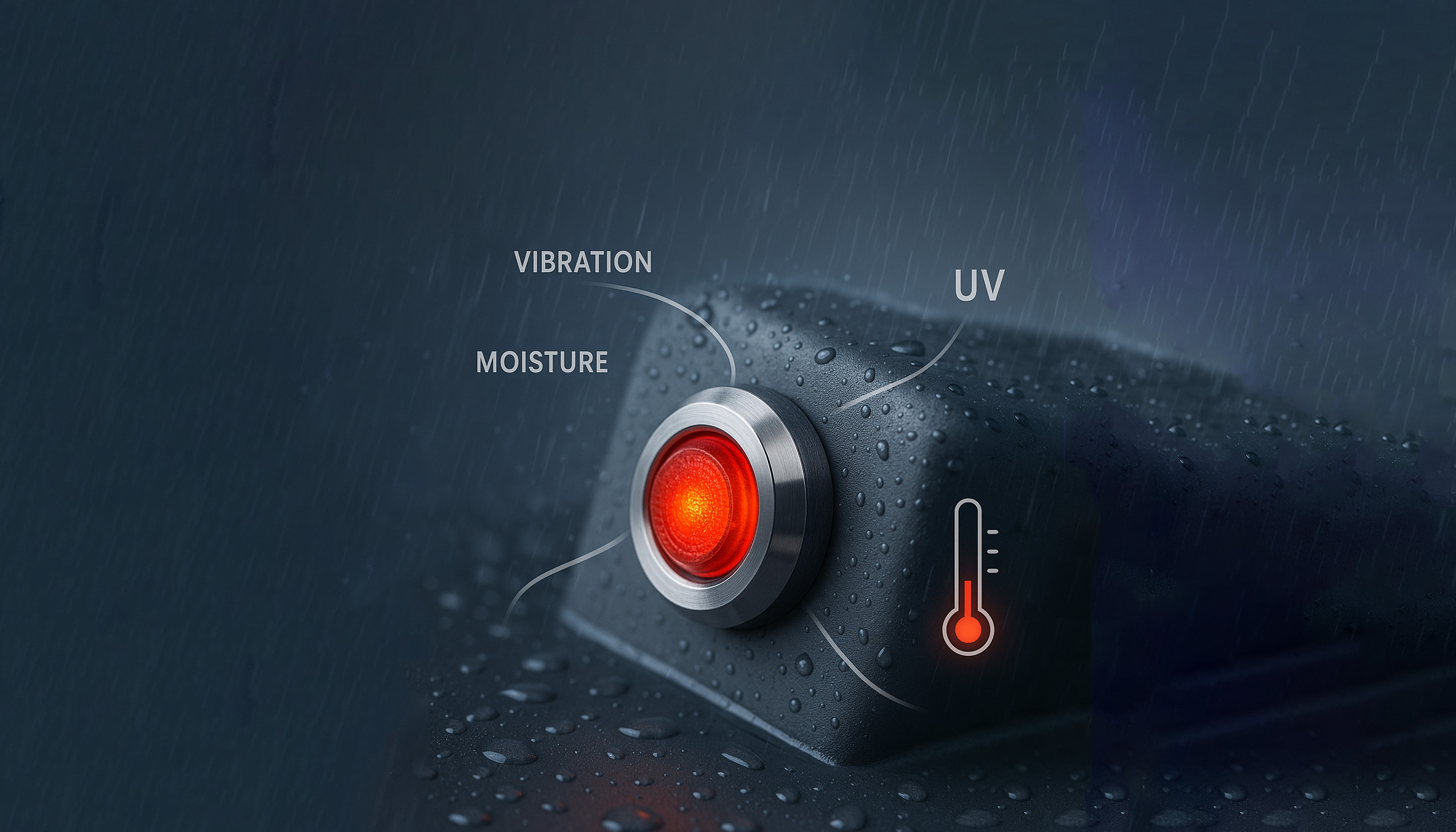
Harsh operating environments present continuous stress to electronic components. Understanding these common environmental stressors is the primary step in selecting the proper LED indicator for harsh environments:
● Temperature Extremes: High heat degrades LED output and shortens overall lifespan in harsh conditions, while extreme cold impacts material properties and renders plastic housing components brittle.
● Moisture and Contaminants (IP Rating): Water, dust, oil, and chemicals enter inadequately sealed indicators, causing short circuits, corrosion, and total system failure. Choosing a high IP rating for LED indicators is crucial to ensure verifiable protection against solids and liquids.
● Vibration and Mechanical Shock: Equipment used in industrial, automotive, or aerospace applications experiences constant vibration and mechanical shock. High vibration resistance in LEDs is vital to prevent loosened connections and internal component damage.
● UV Radiation: Prolonged exposure to ultraviolet (UV) light—particularly in outdoor installations—causes standard plastics to degrade, yellow, or crack. Selecting LED indicators with UV protection is essential to maintain structural integrity and visual brightness in outdoor settings.
● Corrosive Substances: Exposure to acids, alkalis, solvents, and caustic chemicals attacks the housing material of LED indicators, degrading seals and corroding electrical contacts.
● Pressure Variations: In specialized applications, rapid shifts in atmospheric pressure place physical stress on sealed components, directly impacting panel mount indicator design and gasket selection.
Which Technical Specs Are Critical when Evaluating LED Indicators?
Evaluating key technical specifications—such as viewing angle, optical brightness, temperature tolerances, and shock ratings—ensures an LED indicator meets both the visual and mechanical demands of a harsh environment.
Technical specifications must be weighed carefully against actual operating conditions. When selecting panel mount indicators (PMIs) for demanding applications, engineers should prioritize the following core performance parameters:
● Viewing Angle: Determines the spatial range from which the indicator light remains clearly visible. For applications where operators view equipment from off-axis or varied positions, a wider viewing angle is essential to maintain situational awareness and safety.
● Brightness: Measured in millicandela (mcd), brightness dictates visibility under changing ambient light. High-mcd output is required for direct sunlight or brightly lit industrial settings to produce a clear, unambiguous signal.
● Operating Temperature Range: The indicator’s rated operating temperature must exceed the extreme maximums and minimums of your application, preventing thermal performance loss in high heat or material degradation in deep cold.
● Shock and Vibration Resistance: Indicators certified to recognized industry standards (such as MIL-STD-202) ensure internal electrical connections and mountings remain intact under continuous movement and mechanical shock.
● Voltage and Current Requirements: Verifying compatibility with your system’s power supply ensures stable illumination, prevents premature driver failure, and optimizes energy efficiency.
● Lifespan: While LEDs are known for long operational life, harsh ambient temperatures and driving currents can accelerate output decay. Check rated lifespan metrics under realistic operating conditions.
Carefully evaluating these parameters ensures your LED panel mount indicators deliver long-term reliability and clear visual communication in any environment.
Key Physical Design Considerations for Rugged Panel Mount Indicators
Physical design considerations—such as lens materials, housing geometry, gasket seals, and panel thickness—determine whether an LED indicator maintains its mechanical integrity and protective seal when mounted in harsh operating environments.
Integrating an LED into an industrial panel requires balancing electrical specs with mechanical design. To ensure long-term durability, visual clarity, and environmental sealing, engineering teams should evaluate seven key physical design factors:
● Panel Thickness Compatibility: The indicator must match the panel thickness to ensure a tight, secure fit without warping the enclosure or compromising seal integrity under stress.
● Lens Material Selection: Material choice dictates resistance to UV exposure, caustic chemicals, and heavy impacts. Polycarbonate provides maximum toughness, while acrylic offers high optical clarity; both should be UV-stabilized for outdoor use.
● Housing Shape and Size: Housing geometry impacts mounting versatility and physical durability. Compact, low-profile, or rounded housings distribute mechanical stress more effectively, improving resistance to shock and vibration.
● Sealing and Gaskets: High-grade elastomeric gaskets prevent dust, water, oil, and chemical ingress at the mounting cutout, preserving the indicator's rated IP protection.
● Thermal Management: Adequate heat dissipation pathways prevent internal thermal buildup, protecting the LED junction from overheating and premature output decay.
● Mounting Method: PMIs utilize threaded, snap-in, or soldered mounting configurations. Threaded metal options offer the highest retention force and long-term vibration resistance for heavy industrial machinery.
● Wire and Connector Quality: Industrial-grade leads, strain reliefs, and sealed connectors protect electrical contact points from wire fatigue, corrosion, and moisture wicking over time.
Accounting for these structural factors guarantees that panel mount indicators retain their protective seal, visual clarity, and operational safety throughout demanding equipment lifecycles.
VCC Rugged LED PMI Solutions for Harsh Environments
VCC engineers and manufactures high-performance LED panel mount indicators (PMIs) specifically built to withstand harsh industrial, outdoor, and high-reliability operating conditions.
At VCC, we know harsh environments. Our range of rugged LED PMIs is designed to perform where standard indicators fail. Our solutions feature:
● High IP Ratings: Many of our LED PMIs have IP67 or IP68 ratings, providing complete protection against dust and water immersion.
● Robust Construction: Our indicators are constructed from high-grade materials, including stainless steel, anodized aluminum, and UV-stabilized polycarbonate, ensuring they can withstand extreme temperatures, shock, and vibration.
● Wide Operating Temperature Ranges: Designed for operation in various climatic conditions, from arctic cold to desert heat.
● Excellent Optical Performance: Wide range of viewing angles and brightness levels for clear indication in any lighting condition.
Frequently Asked Questions (FAQs)
What IP Rating Is Best for Outdoor or Washdown LED Indicators?
For harsh outdoor environments, IP67 or IP68 ratings are ideal. An IP67 rating ensures complete protection against dust and temporary water immersion, while an IP68 rating protects against continuous submersion and high-pressure washdowns.
What Is the Difference Between Polycarbonate and Acrylic Lenses in Harsh Environments?
Polycarbonate lenses provide high impact resistance and toughness against mechanical shock, making them suitable for heavy industrial machinery. Acrylic lenses offer optical clarity and chemical resistance; both materials require UV-stabilized treatments for outdoor use.
How Does Vibration Affect Standard Panel Mount Indicators?
Continuous mechanical vibration can loosen internal electrical connections, crack standard plastic housings, and degrade solder joints over time. Rugged PMIs use threaded metal housings, shock-tested internal builds (e.g., MIL-STD-202), and heavy-duty gaskets to maintain operational integrity under constant movement.