Back to Articles
Engineered Light Control: Precision Geometry & Simulation for Light Pipes
In the intricate world of modern product design, illumination is far more than just turning on a light. It is about precise control, aesthetic integration, and reliable performance that directly impacts user experience and product functionality. Custom light pipes are the unsung heroes of this domain, efficiently channeling light from an LED source to its intended destination, whether it is a critical indicator or a sophisticated display. At VCC, we do not just move light. We engineer its journey with unparalleled precision, transforming illumination challenges into seamless, high-performance solutions.
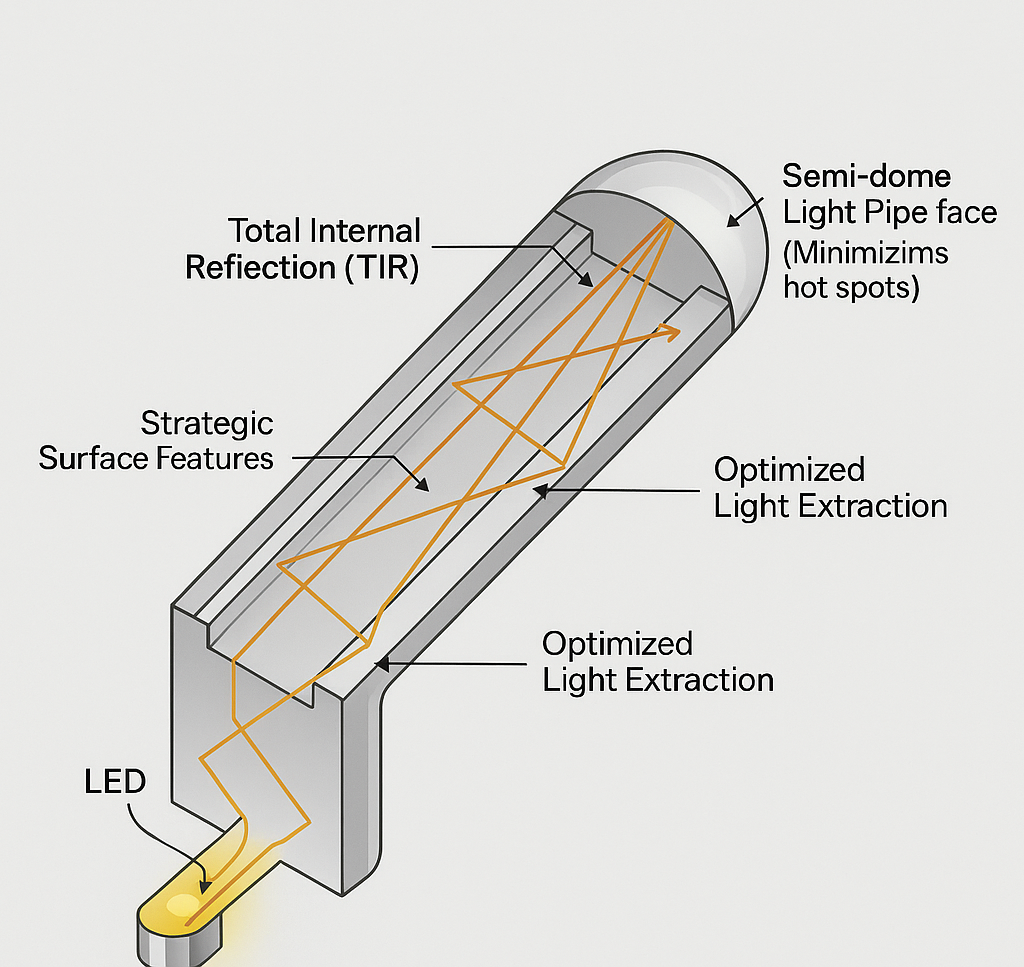
The fundamental principle governing light pipe efficiency is Total Internal Reflection (TIR). When light travels through a denser medium, such as optical-grade plastic, and strikes an interface with a less dense medium (typically air) at an angle greater than its critical angle, it reflects entirely back into the pipe. This phenomenon allows optical energy to travel along the length of the light guide with minimal loss.
However, effective light pipe design involves a fundamental balance. While TIR is crucial for containing light during transmission, it must also be strategically broken to allow light to exit at the desired location and with the intended distribution. Without controlled disruption, light remains trapped within the light guide. Balancing TIR maintenance for transmission with deliberate extraction for controlled output is where VCC's precision optical engineering excels.
VCC's Precision Optical Geometry in Action: Engineering Light with Intent
At VCC, optical geometry is far more than a simple design parameter. It is a meticulously crafted science. We engineer every internal and external surface contour of the light pipe to precisely control light behavior:
● Strategic Surface Features: We integrate specialized internal surface features, micro-textures, and optical coatings engineered to interrupt TIR at exact locations. These features alter the angle at which light strikes the outer interface, directing it to exit the light pipe precisely where needed to ensure uniform illumination and minimal light loss.
● Optimized Light Extraction: Designs are tailored to achieve specific illumination targets, including precise light shaping for complex displays and targeted directional beam patterns. For instance, our semi-dome light pipe faces minimize central hotspots to deliver a soft, uniform glow across wide viewing angles, such as the 120-degree field of view on our LFB Series or custom configurations reaching up to 160 degrees.
● Eliminating Optical Imperfections: We proactively eliminate common illumination issues such as LED light bleed and localized hotspots. Our optical geometry ensures light exits the display face cleanly, preventing unwanted light leakage, cross-talk, or visual distortion.
This level of detail in optical geometry allows VCC to deliver custom light pipes that achieve superior performance, ensuring visual clarity, consistency, and clean aesthetic appeal in your final product.
The Power of Advanced Simulation and Optical Modeling
Bringing intricate optical geometries to life requires more than theoretical knowledge. It demands advanced tools. VCC leverages state-of-the-art light modeling software and ray tracing capabilities to perform thorough optical light simulations.
Our simulation-driven design process allows us to:
● Virtual Prototyping: We track the exact path of light rays through proposed light pipe geometries in a virtual environment. This enables our engineering team to devise optimal illumination solutions and accurately predict optical performance before committing to physical material.
● Optimize and Refine: Through iterative simulations, designs are refined until all target optical requirements are met. This process helps virtually eliminate light loss while proactively identifying and resolving issues like hotspots and light bleed during early design stages.
● Reduce Costs and Accelerate Development: Validating performance virtually reduces the need for expensive physical tooling modifications and shortens overall development cycles. This translates to faster time-to-market and lower development risk for your product.
From Design to Reality: VCC's Rapid Prototyping and Manufacturing Precision
Once simulations confirm the viability of a design, VCC moves swiftly to physical prototyping and production. We utilize in-house 3D printing capabilities to produce functional plastic light pipe prototypes. These prototypes are remarkably accurate, typically achieving 90% fidelity compared to the final injection-molded product. This high level of accuracy provides design teams with the confidence to approve final tooling investments, knowing the design has been thoroughly validated in a physical form.
Once tooling is finalized, production transitions to our state-of-the-art manufacturing facility in Mexico, where fabrication and assembly are conducted with high precision and quality control. This nearshore manufacturing capability offers distinct advantages, including simplified supply chain logistics, enhanced quality assurance, and faster delivery schedules.
The VCC Advantage: Your Partner in Advanced Illumination
Choosing VCC for your custom light pipe needs means partnering with a leader in precision optical engineering. Our multidisciplinary team of mechanical, optical, and electrical engineers possesses a deep understanding of the complexities involved in light pipe design, from material selection to optical geometry and viewing angle optimization.
We deliver solutions that meet your exact luminosity requirements while integrating seamlessly alongside sensitive PCB components. Our custom light pipes provide:
● Design Flexibility and Control: Tailored geometries that adjust length, exit angles, and spacing for exact visual indication and uniform light distribution.
● Reduced Production Costs: Streamlined component designs that simplify your Bill of Materials (BOM) and reduce overall manufacturing assembly expenses.
● Minimized Light Loss: Precision-molded optical paths that virtually eliminate internal light losses for maximum optical efficiency.
● Uniform Illumination: Clean, consistent light output that enhances both operational interface clarity and end-product aesthetics.
● Accelerated Time-to-Market: Integrated simulation, rapid 3D prototyping, and nearshore production that cut development cycles and bring your product to launch faster.
Frequently Asked Questions (FAQs)
What Is Optical Geometry in Custom Light Pipe Design?
Optical geometry refers to the precise engineering of a light pipe's internal and external surface features to control how light travels, extracts, and disperses. VCC uses optical geometry to optimize light extraction, minimize transmission losses, eliminate hotspots and light bleed, and ensure uniform illumination across the viewing face.
How Does Optical Simulation Improve Custom Light Pipe Performance?
Optical simulation enables engineers to model and analyze light ray paths through proposed light pipe geometries before cutting physical tooling. VCC leverages ray tracing software and light modeling tools to refine surface geometries, identify potential hotspots or light leakage, and validate optical efficiency early in the design phase.
Why Is Rapid Prototyping Important for Custom Light Pipe Development?
Rapid prototyping allows engineering teams to physically test and evaluate light guide performance after digital validation. VCC utilizes in-house 3D printing to produce functional prototypes that achieve up to 90% fidelity compared to final injection-molded parts, providing confidence before committing to production tooling investments.