Back to case studies
Market Background
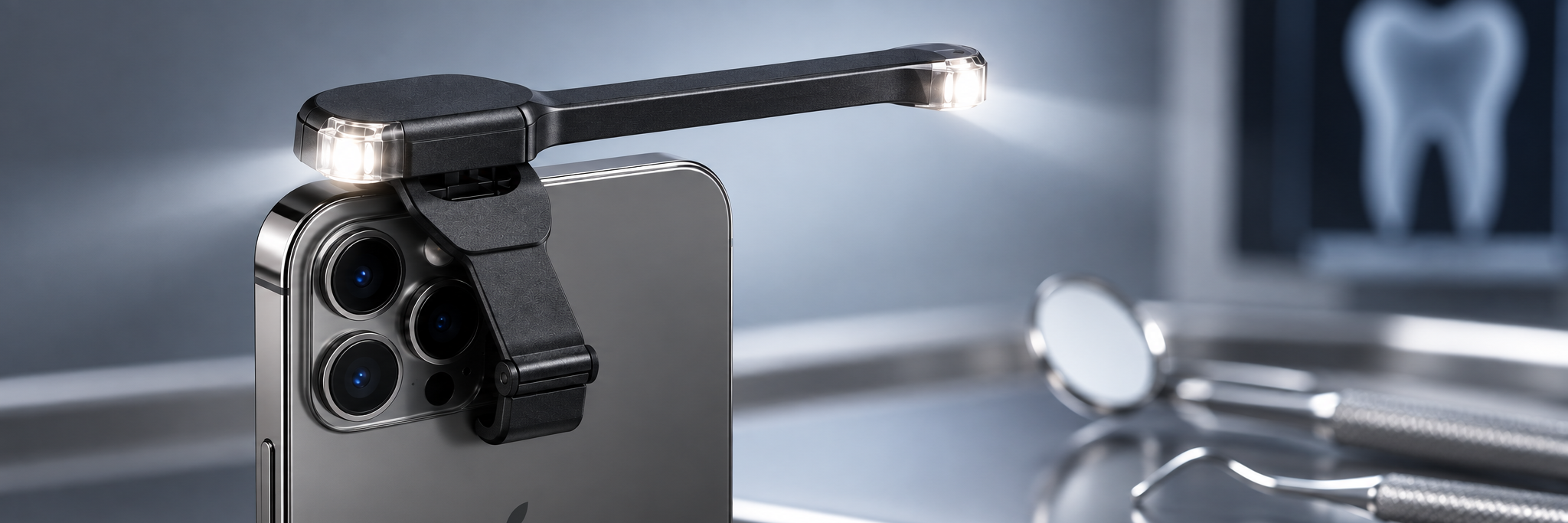
For decades, capturing diagnostic-quality images inside a patient's mouth required a dedicated intraoral camera system. The high equipment costs and inventory burdens of these standalone hardware units kept high-quality chairside imaging out of reach for smaller practices. Meanwhile, modern smartphone cameras have advanced sufficiently to resolve detailed tooth surfaces, but illumination remains a major obstacle. Because a phone’s built-in flash sits adjacent to the camera lens, it cannot effectively project light into dark, enclosed oral cavities. Solving this illumination challenge allows dental practices to turn the smartphones they already own into versatile, accessible intraoral imaging tools.
Customer Challenge
A software company specializing in dental workflow and image-management tools recognized an opportunity to replace expensive, standalone cameras with smartphone-based imaging. While the client’s software team could develop the application interface, the company lacked in-house optical and mechanical engineering capabilities to build the required physical attachment.
The project required a compact hardware attachment capable of capturing light from a phone's built-in LED, routing it around the device, and projecting it evenly into the camera’s viewing field. Initial optical evaluations conducted by Visual Communications Company (VCC) revealed a severe light-loss problem: placing a single light pipe directly against the phone’s flash LED collected only 3.24% of the source output, and using dual pipes raised collection to just 6.5%. Furthermore, the attachment had to fit various smartphone models rather than a single prototype phone, requiring a universal mechanical solution.

Our Solution
Optical Redesign: From Direct Contact to TIR
To overcome early light-loss limits, VCC turned to total internal reflection (TIR). After early TIR concepts improved collection but remained constrained by LED spot size and pipe height, VCC redesigned the coupling stage into a two-part system. A convex lens collimates the LED's wide-angle output, while a TIR collector folds that collimated light into two light pipes, raising coupling efficiency from 3.24% to 49.1%.

| Design Stage | Efficiency | Basis |
|---|---|---|
| Direct contact (single light pipe to LED) | 3.24% | Baseline light study |
| Direct contact (two light pipes to LED) | 6.5% | Baseline light study |
| First TIR concept iteration | 10.92% | Optical simulation |
| Second TIR concept iteration | 38.9% | Optical simulation |
| Final convex lens + TIR collector design | 49.1% | Optical simulation |
| Full system efficiency (Fresnel + pipe + bending loss) | 11.6% | Final design, 70° full view angle |
Accounting for Fresnel reflection, transmission, and bending losses across the device, VCC’s complete model achieved an 11.6% full system efficiency at a 70° view angle. Each 120 mm pipe was specified with a 1.0 mm PMMA core, maintaining an intrinsic transmission loss of just 1.06% at 625 nm.
| Parameter | Value |
|---|---|
| Core material | Polymethyl methacrylate (PMMA) |
| Core diameter | 1.0 mm |
| Core refractive index | 1.49 |
| Numerical aperture | 0.58 |
| Cladding material | Fluorinated polymer |
| Jacket material | Cross-linked polyethylene (black) |
| Outer diameter | 1.5 mm ± 0.05 mm |
| Minimum bend radius | 2.0 mm |
| Operating temperature range | -55°C to 105°C |
| Pipe length (as installed) | 120 mm |
| Calculated transmission loss | 1.06% at 625 nm |

Mechanical Design: One Module, Any Phone
Beyond optics, VCC had to fit the attachment within tight intraoral space limits, keeping height below early 13.5 mm benchmarks while routing pipes around a 2.0 mm minimum bend radius. The key innovation was separating the optical module from the phone attachment: keeping one standard optical assembly (pipes, prisms, collector, lens) constant while swapping lower-cost clips to fit different smartphone geometries.
A spring-loaded light collector slides into place to ensure auto-alignment to the clip lens across phone models. VCC engineered the unit for efficient manufacturing, utilizing press fits, optical glue, heat staking, and snap fits for streamlined assembly.
Result & Benefits
By owning both the optical and mechanical engineering disciplines, VCC transformed a severe light-loss issue into a fully manufacturable, scalable product.
● Single-Partner Co-Design: VCC managed both optical and mechanical engineering, shielding the software client from managing multiple hardware vendors.
● Modular Versatility: Standardizing the optical core lowered tooling costs while expanding hardware compatibility across phone models via clip swaps.
● Rapid Tooling Transition: The completed design moved directly into manufacturing planning within 3 to 4 weeks.
Conclusion
This project highlights the value of unified optical and mechanical engineering when developing mobile healthcare imaging tools. VCC converted a light-coupling efficiency measured in single digits into a clinically viable 11.6% total system output, all while creating a swappable clip design that adapts to diverse smartphone hardware. For software-driven companies looking to leverage mobile device platforms, VCC provides the optical expertise and mechanical integration needed to turn complex hardware concepts into production-ready reality.