Back to Articles
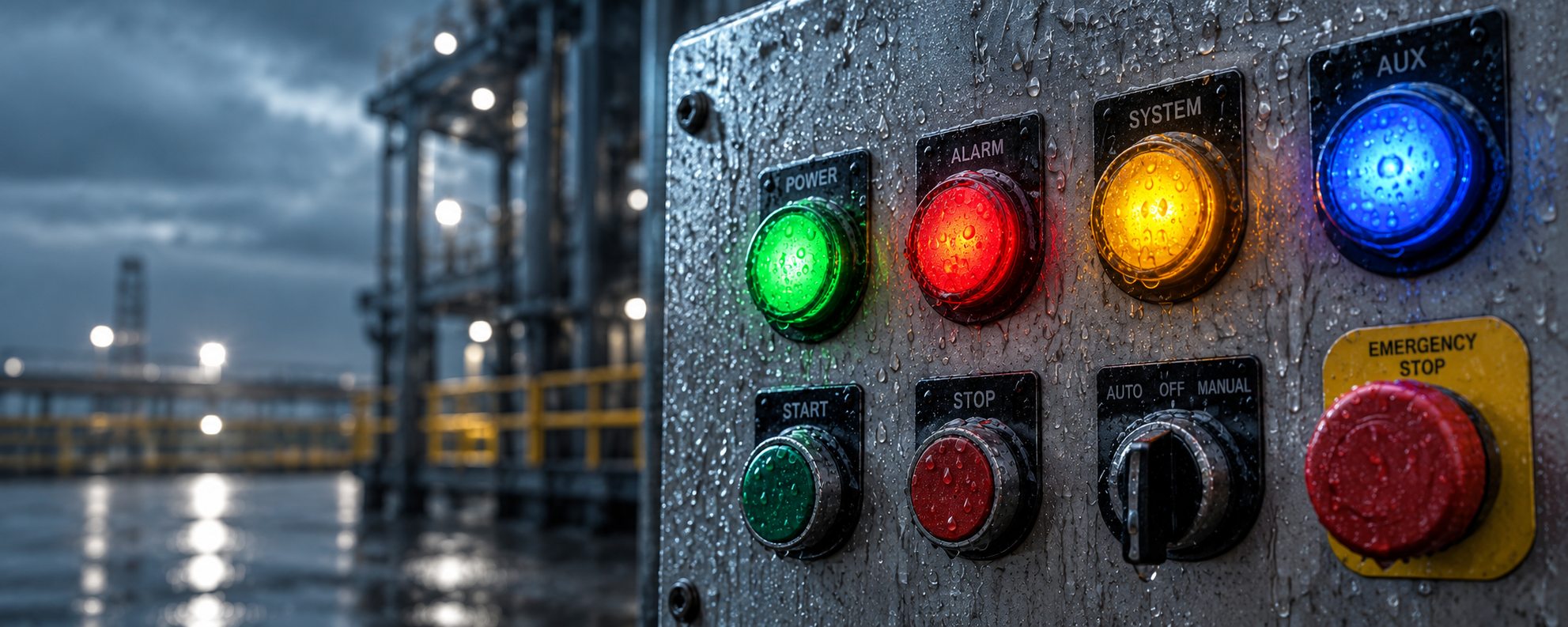
A panel indicator that shrugs off two winters of rain on a dockside gantry can fail in a week on a dairy bottling line. Both environments are wet, but the water arrives differently, one as low-pressure spray and the other as a hot caustic jet aimed at the bezel from arm's length. IP65, IP66, and IP67 describe those differences, and the three ratings are not a simple ladder from good to better. Reading them that way puts a sealed switch in front of a hose it was never tested against.
What Do the Digits in IP65, IP66, and IP67 Actually Specify?
IEC 60529 gives every enclosure two digits, the first for solid particles and the second for liquids. All three of these ratings carry a 6 in the first position, which means dust-tight, so the difference between them sits entirely in the second digit and the water test behind it. IP65 covers water jets, IP66 covers powerful water jets, and IP67 covers 30 minutes of immersion at one meter.
That shared first digit does more work in a mill or a grain terminal than most specifications acknowledge. To earn a 6, the device sits in a talc-dust chamber for up to eight hours with a partial vacuum drawn inside it, and no dust may enter. A 5 in that position allows a limited quantity of dust as long as it does not interfere with operation, which is a reasonable allowance for a clean assembly area and a poor one for a switch whose contacts have to stay clean in airborne flour or cement. VCC's designer's guide to IP ratings for electronic indicators walks through the full two-digit system, the ratings below IP65, and the supplementary letters that follow the code.
The three tests differ in nozzle diameter, flow rate, and pressure, which together decide how much energy the water carries when it reaches the seal. IP65 and IP66 both spray the enclosure from 2.5 to 3 meters away, while IP67 replaces spray with a static immersion.
| Test Parameter (IEC 60529) | IP65 | IP66 | IP67 |
|---|---|---|---|
| Water condition | Jets | Powerful jets | Temporary immersion |
| Nozzle diameter | 6.3 mm | 12.5 mm | Not applicable |
| Flow rate | 12.5 L/min | 100 L/min | Not applicable |
| Pressure at nozzle | 30 kPa | 100 kPa | Static head only |
| Distance or depth | 2.5 to 3 m | 2.5 to 3 m | Lowest point 1 m below surface |
| Duration | 3 minutes minimum | 3 minutes minimum | 30 minutes |
| Pass criterion | No harmful ingress | No harmful ingress | No harmful ingress |
The jump from IP65 to IP66 multiplies flow by eight and pressure by more than three, so a seal that holds against a garden hose can be walked through by a plant washdown wand. IP67 asks a different question again, testing whether the enclosure keeps out standing water for half an hour with no dynamic force behind it at all.
Why Doesn't a Higher IP Number Always Mean Better Protection?
Above 6, the second digit stops being cumulative. IEC 60529 treats powerful jets and immersion as separate tests, so a part marked IP67 has not necessarily faced a 100 L/min jet, and suppliers who verify both conditions mark the part IP66/IP67. Specifying by the highest single number can leave a marine console with a seal that leaks the first time a deckhand aims a hose at it.
The two failure mechanisms explain why. Immersion loads a gasket with a steady, evenly distributed head of roughly 10 kPa, while a jet concentrates several times that pressure on one point of the seal and drives water into any gap in the bezel or the panel cut-out. For any HMI that faces both conditions, engineers should ask the supplier for dual marking rather than inferring one result from the other.
What Does an IP Rating Leave Out for Washdown and Marine Service?
IP testing uses fresh water at close to ambient temperature with no detergent, no chemical loading, and no thermal shock, so the rating says nothing about the three conditions that most commonly kill sealed human-machine interfaces (HMIs) in food plants and on open decks: hot caustic cleaners, salt corrosion, and pressure differentials created by temperature swings.
Thermal cycling causes the failure that surprises maintenance teams. When a cold jet hits an enclosure warmed by its own electronics, the air inside contracts and pulls water past the seal, and no static immersion test reproduces that suction. Designers manage the effect with potting, breather membranes, or a sealed cavity behind the front panel, and the choice belongs in the specification alongside the IP number.
Chemistry and materials carry the rest of the risk. Gasket compound decides service life more than gasket geometry does, because silicone tolerates a wide temperature range but swells in oils, EPDM handles hot water and steam yet degrades in hydrocarbons, and nitrile does the reverse. On salt-exposed installations, the corrosion question is separate from the ingress question, and engineers typically call out salt-mist testing to IEC 60068-2-52 or ASTM B117, 316 stainless hardware, and UV-stable polymers for the bezel and the panel mount indicator lens.
What Do the M and S Suffixes Mean for HMIs With Moving Parts?
IEC 60529 adds the supplementary letters M and S to record whether a device's moving parts were operating during the water test. M means the lab ran the test with the parts in motion, and S means the device stayed still, so an IP67M rating is a harder result to earn than IP67S on the same hardware.
Moving actuators matter here because the shaft seal, not the front panel, is usually the weak point. Rotary selector switches, joysticks, and long-travel pushbuttons open a small dynamic clearance every time an operator uses them, which is exactly the moment a washdown jet finds a path inside. Most published ratings omit the letter entirely, and an unsuffixed rating leaves the motion condition unspecified, so procurement teams sourcing industrial switches for washdown duty should ask which state the supplier tested.
How Do NEMA Ratings Compare With IP65, IP66, and IP67?
NEMA enclosure types and IP codes map onto each other in one direction only. NEMA Type 4 corresponds approximately to IP66 and Type 6 to IP67, but NEMA adds requirements that IEC 60529 never tests, including external icing, gasket aging, and corrosion resistance for the X suffix. A NEMA type therefore satisfies its IP equivalent in most cases, while an IP rating on its own does not establish the NEMA type.
That asymmetry shapes how buyers write specifications on either side of the Atlantic. North American food and marine specifications tend to ask for Type 4X, European and Asian ones for IP66 or IP66/IP67, and suppliers serving both markets publish the two ratings side by side. When only an IP rating appears on a datasheet and the plant standard is written in NEMA terms, the corrosion and icing gaps are the ones to close first.
Which IP Rating Should You Specify for Your HMI Application?
Match the rating to the water event the device will actually see, then add the environmental requirements that IP does not cover.
● Indoor panels with splash, hose-off, or weather exposure: IP65 is adequate where cleaning happens with a low-pressure hose and no chemical loading.
● Daily washdown in food, beverage, and pharmaceutical plants: IP66 as a floor, with IP69K worth specifying where crews clean with 80 to 100 bar jets at 80 °C.
● Exposed marine decks, bridge wings, and dockside equipment: IP66/IP67 dual marking, plus salt-mist data and corrosion-resistant hardware.
● Low-mounted controls at risk of standing water or flooding: IP67 as a minimum, or IP68 where the depth and duration are known and continuous.
● Any device with a rotating or long-travel actuator: an M-suffix rating, or written confirmation of the test condition.
Cost tracks these decisions more closely than the digit suggests. Moving from IP65 to IP66 usually changes the gasket and the panel-mount hardware, while reaching IP67 or IP69K can require potting, welded bezels, or a different actuator design, and those changes carry through to tooling and lead time.
How Long Does an IP Rating Hold Up in Service?
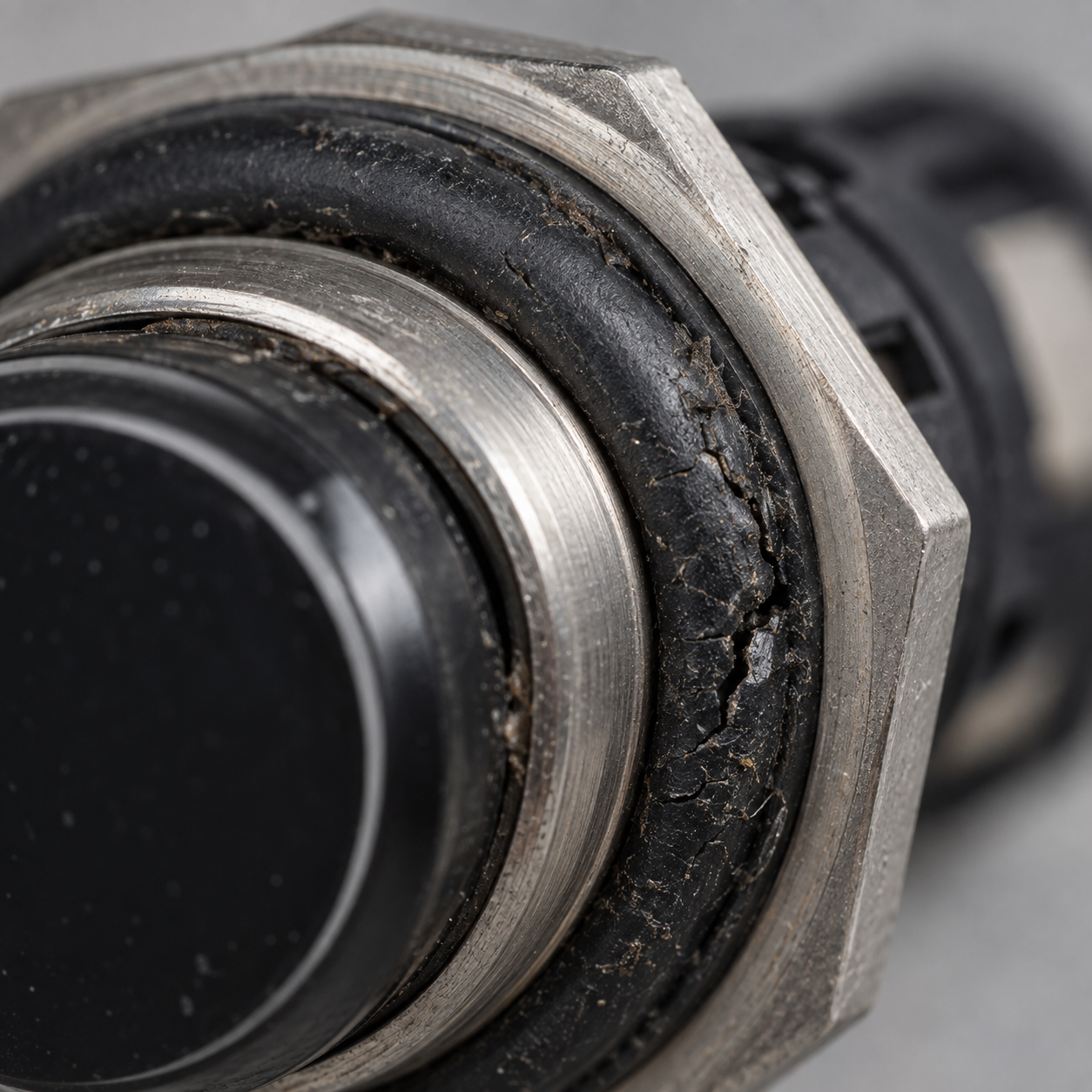
An IP rating describes a new device tested on a bench, and the seal begins aging the moment an installer torques it into a panel. Compression set in the elastomer, an oversized or burred panel cut-out, and under-torqued fasteners each open a leak path that no rating can predict.
Cleaning chemistry speeds up the same process, because repeated exposure to hot caustics hardens many gasket compounds and shortens the elastic recovery the seal depends on. Maintenance teams get the most out of a rated device by inspecting gaskets at scheduled shutdowns, replacing panel gaskets rather than reusing them after any removal, and directing washdown jets away from seams and actuator shafts where the housing allows it.
Where HMI Sealing Specifications Are Heading
Plant and vessel engineers are steadily abandoning single-number sealing specs, and the parts market is following them. Dual IP66/IP67 marking has become common on industrial switch and indicator lines, IP69K has spread from road vehicles into food processing, and datasheets now list salt-mist hours and chemical compatibility next to the IP code. Each addition closes a gap that a bare IP number left to guesswork.
The practical result is a specification that names the test rather than the number: the pressure and temperature of the water, the chemistry of the cleaner, the motion state of the actuator, and the corrosion exposure of the site. An HMI specified that way survives the environment it was bought for, which is a different achievement from passing a three-minute spray test in a lab.